

When to use high-volume sending
Use High-volume email sending when you see throttling, delayed delivery, or reduced deliverability using inbox-based sending (Microsoft/Google). This option is designed for transactional / recruiting outreach at scale, while still sending from your domain.This setup requires DNS changes
Unlike inbox-based sending (Microsoft/Google OAuth), high-volume sending requires updating your DNS so Tenzo can:- Send authenticated email from your domain (DKIM plus a return-path CNAME)
- Receive candidate replies so Tenzo can continue the conversation
What this changes (and what it doesn’t)
- From: candidates see emails coming from the recruiting email address you configure (e.g.
morgan@recruiting.company.com). - Reply experience: candidates can hit “Reply” normally and Tenzo will receive replies to continue the conversation.
- Inbox visibility: emails are not sent “from an employee mailbox” (so they may not appear in Outlook/Gmail Sent Items).
Optional: use a subdomain
Using a subdomain is optional, but it’s often a good idea because it can:- Isolate reputation: keeps recruiting/outreach traffic separate from your main corporate email traffic
- Reduce operational risk: makes it easier to roll back or adjust recruiting email settings without touching your primary domain
- Simplify deliverability work: clearer DNS/auth boundaries for recruiting email
morgan@recruiting.company.comrecruiting@company.com
DKIM selector conflicts (SendGrid)
Some customers already have DKIM records on their base domain from other email providers. SendGrid’s default DKIM selectors (s1 / s2) can conflict with those existing records.
Tenzo automatically generates a unique DKIM selector for your setup to avoid collisions. When you use a recruiting subdomain, Tenzo keeps the SendGrid authentication records scoped to that recruiting subdomain.
Setup steps
- In Tenzo, go to Admin → Office Integrations → Email Integrations
- Select High-volume sending (Recommended)
- Enter your recruiting email address
- Choose Inbound reply routing:
- Dedicated reply subdomain (recommended if sending from a root domain to protect your main corporate email), or
- Use sending subdomain directly (recommended if you already send from a Tenzo-dedicated recruiting subdomain)
- Click Begin setup
- Add the DNS records Tenzo shows (the DKIM CNAMEs, the return-path CNAME, and the inbound MX record)
- After DNS propagates, click Check DNS. Tenzo looks up the CNAME rows shown in setup (both DKIM records and the return-path CNAME) in public DNS — not only SendGrid’s own “domain valid” flag — so a missing DKIM record fails the check.
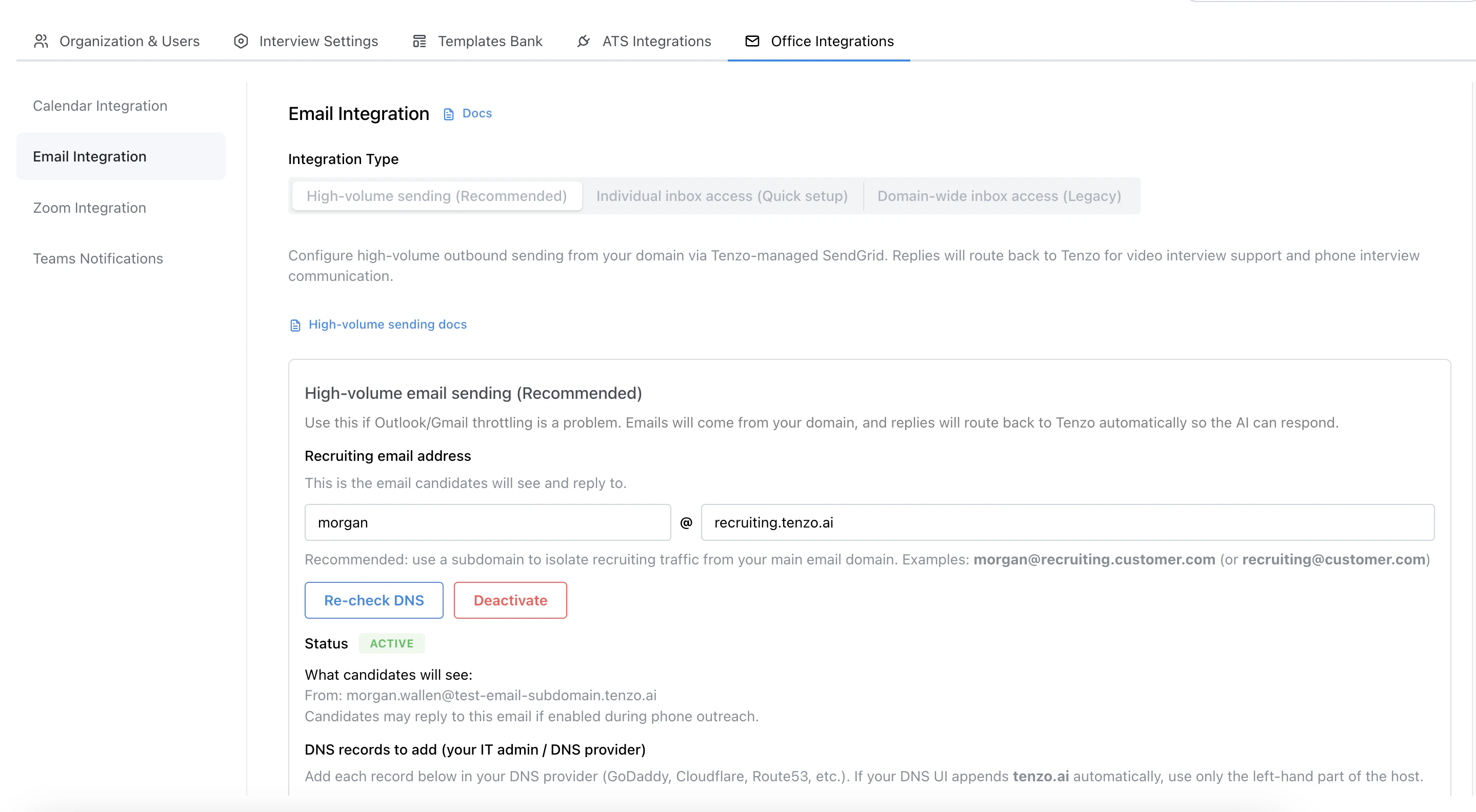
High-volume sending setup
DNS records (what they do)
Tenzo will show the exact DNS records to add. Common records include:- DKIM (CNAME): enables cryptographic signing for your domain
- Return-path CNAME: points bounce/envelope-from traffic at SendGrid so they can authorize sending from their infrastructure. You do not add a separate SPF TXT record.
- Inbound MX record: routes candidate replies back to Tenzo
Inbound reply routing options
When you set up high-volume email, choose how candidate replies are routed in DNS:
Examples if you send from
recruiting.customer.com:
- Dedicated reply subdomain → MX on
reply.recruiting.customer.com. Candidate replies go to addresses likerecruiting+code@reply.recruiting.customer.com. - Use sending subdomain directly → MX on
recruiting.customer.com
recruiting@customer.com) must use the dedicated reply subdomain option so your main corporate email MX is not affected.
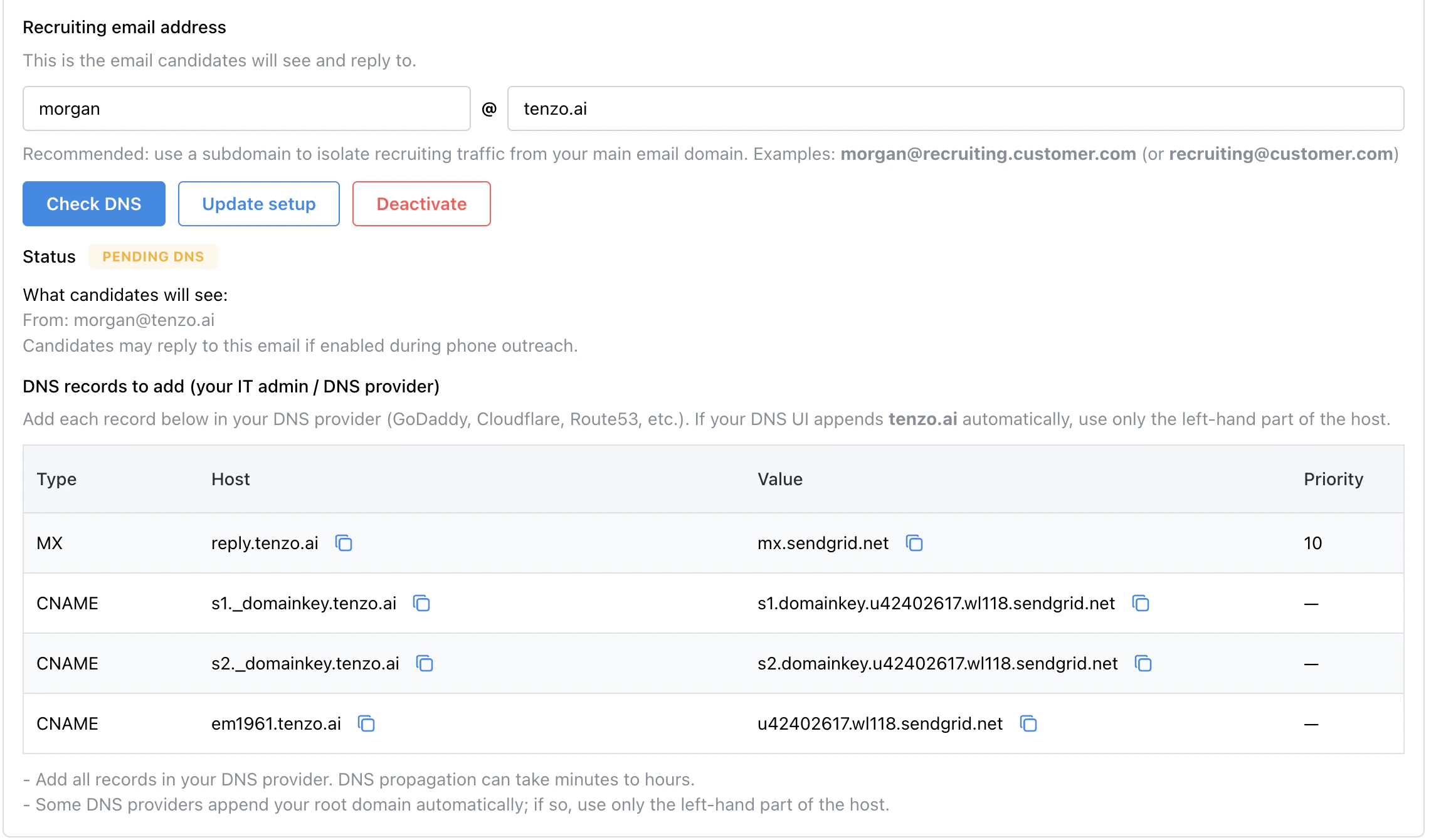
DNS records to add
Why inbox-based sending can throttle at high volumes
When you connect an individual inbox (or domain-wide access), Tenzo is sending “as a mailbox user” in Microsoft/Google. Those providers apply per-user/mailbox sending limits and anti-abuse controls that can trigger throttling. Typical caps (varies by tenant/account and can be lower in practice):- Google Workspace (Gmail): up to ~2,000 recipients/day per user (consumer Gmail accounts are typically lower, ~500/day)
- Microsoft Exchange Online: published limits can be higher (e.g. ~10,000 recipients/day), but practical anti-abuse limits for external recipients may be much lower for some tenants/mailboxes (for example, you may see alerts around a few hundred external recipients/day).
Troubleshooting
DNS says “not verified”
- DNS changes can take time to propagate; try again in 10–30 minutes.
- Double-check there are no typos in Host/Value. Check DNS looks up the CNAME rows shown in setup (both DKIM records and the return-path / sending-domain CNAME) in public DNS. If a row is missing, the check fails and shows the exact host and expected value — even if SendGrid previously marked the domain valid. Those same rows stay on the setup page after each check.
- Both DKIM CNAMEs must exist. Inbox providers (especially Gmail) cannot authenticate mail without them, so outreach may land in spam.
- Tenzo waits about two days after you create the high-volume integration before emailing admins about unfinished DNS, then at most once every three days while it stays pending.
- If DNS stays unverified or validation errors, Tenzo emails org admins (and BCC’s support@tenzo.ai) with a link back to Admin Settings → Office Integrations → Email so someone can finish setup. Use Check DNS after records propagate.