

Conversation Settings
Voice
Select the caller’s accent, name, or gender profile, adapting to the candidate’s language when Multilingual is enabled.
Voice
Language
- Defines which language the interview is conducted in.
- Options:
- Multilingual: Automatically translates between supported languages based on the candidate’s responses. The call opens in a language the candidate used during earlier text outreach, provided it is one of the allowed languages, and otherwise in the language of the screening questions.
- Candidate Choice: Allow candidate to select the language of their video interview interface before the call, adjusting the language displayed in the video portal and the language the interview will be conducted in. For phone calls, this setting will behave like multilingual.
- Specific language: The AI will only respond in the selected language. Some languages are available as regional variants, such as French (Canada), French (France), Spanish (Latin America), and Spanish (Spain). For best performance, write your screening questions in the selected language and region when only one is selected, else there will be a mismatch between the language the candidate is expected to speak and the interview the agent is configured to deliver. If the candidate speaks a different language than selected, this will not be transcribed and the interviewer will continue to conduct the interview in the configured language.

Language
Limit Interviewer Languages
Optionally limit which languages the interviewer can use by specifying allowed languages if multilingual or candidate choice is selected. Regional language variants are listed separately when available, so you can allow, for example, Spanish (Latin America) without also allowing Spanish (Spain). If candidate choice is selected for video interviews, the candidate will only be able to choose between the languages in this limited list. Leaving the list empty is not the same as allowing every language: the interview falls back to English, Spanish and French, so add any other language you want the interviewer to use.AI Caller Name
Set the display name of the AI caller shown to candidates (this will default to “Morgan” if not selected).
AI Caller Name
AI Interviewer Responsiveness
Control how frequently the interviewer follows up on candidate responses, from “To the point” to “Inquisitive” or a custom level. “Conversational” is a safe default for most interviews.
AI Interviewer Responsiveness
Professionalism
Choose whether the AI speaks in a more casual conversational style or a more formal professional tone.
Professionalism
Boosted Transcription Keywords
Improve transcription by adding up to 20 job-specific keywords or phrases the AI should recognize more reliably. This can help improve performance for tough to transcribe words or acronyms. If you see a consistently mis-transcribed word, it is a good idea to add it to the boosted keywords.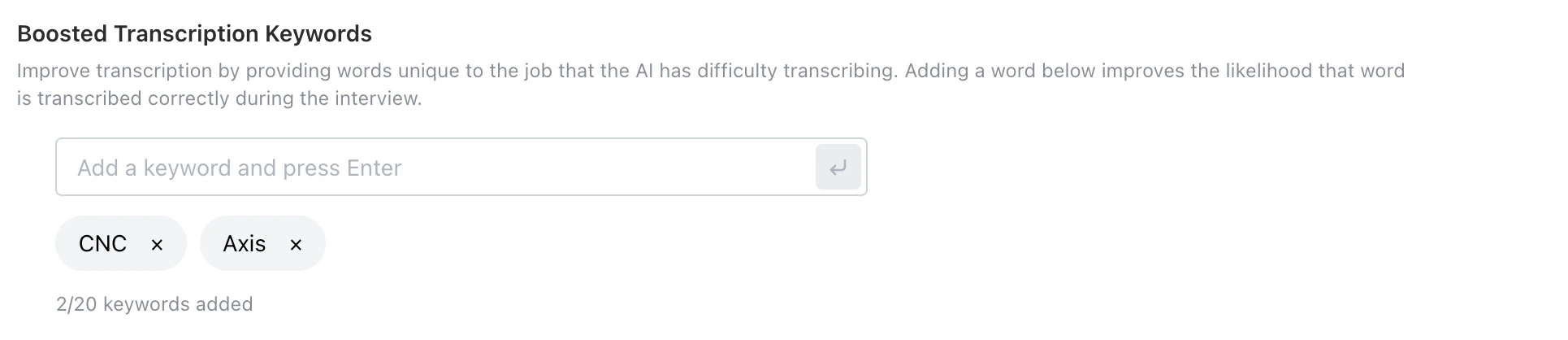
Boosted Transcription Keywords
Outreach Settings
Call Type for Applicants
Select whether applicant candidates receive phone calls and sms messages, or a link to a video interview sent via email. Some additional settings are dependent on the call type.Call Type for Sourced Candidates
Select whether sourced candidates receive phone or video calls, optionally matching the applicant call type.- Recommendation: Customers see better performance with phone calls for sourced candidates, as most candidates who did not recently apply are more likely to respond to an sms or pick up the phone for a quick call than click on an emailed invitation to a job.
Use the same messaging as applicants
Choose whether sourced candidates should use the same call intro / SMS / email messaging as applicants. If not enabled, sourced candidates will receive messaging optimized for non-applicants.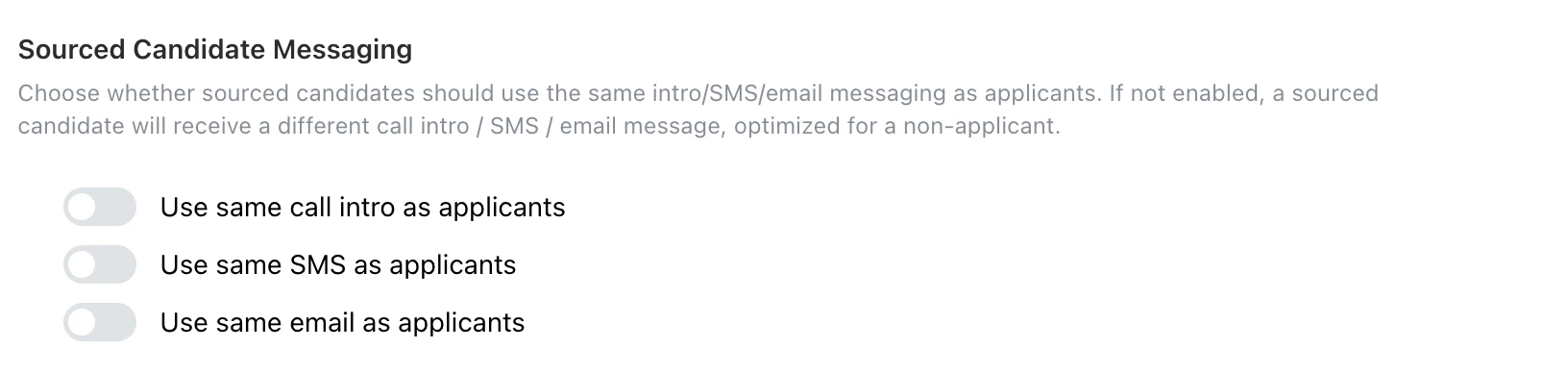
Use the same messaging as applicants
Outreach Hours
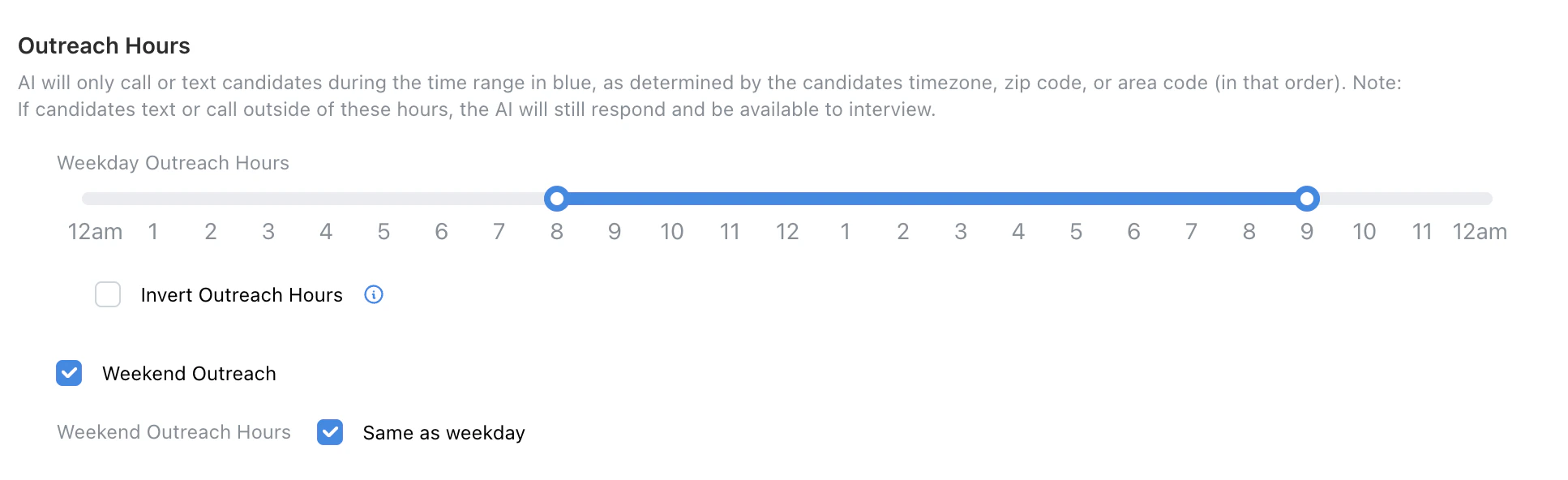
Define when the AI is allowed to call or text candidates, including weekday/weekend windows.- Details:
- Respects candidate timezone, ZIP code, location point (city/state when no ZIP), area code, your organization’s Default candidate timezone, then your organization’s timezone (in that order). UTC is used only if organization timezone data is missing.
- Outside of these hours, candidates may still interact and the AI recruiter will still respond and be available to conduct interviews, but proactive outreach is limited.
- Additional Controls:
- Weekday Outreach Hours
- Invert Outreach Hours: An uncommon toggle to only contact candidates outside of normal business hours.
- Weekend Outreach: Optionally configure different hours.
Outreach Hours
Phone Call Outreach Settings
Initial Phone Outreach Method
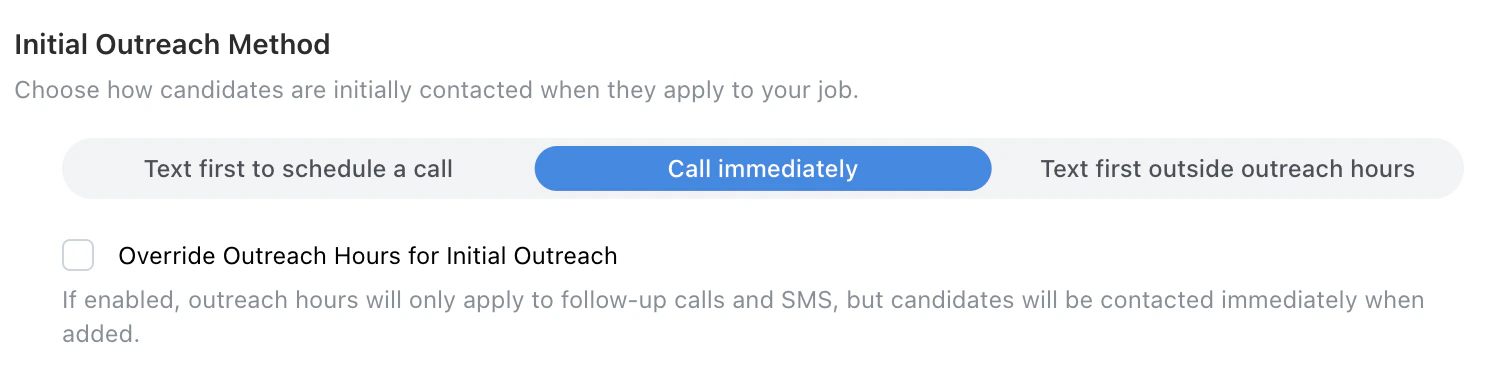
Choose how candidates are first contacted. There are three options:- Text first to schedule a call — always open with an SMS (plus a companion email).
- Call immediately — always open with a phone call.
- Text first outside outreach hours (default) — call when the first attempt falls inside outreach hours; when it falls outside, text immediately and schedule the first call for the next outreach-hours start. Later retries use the job’s retry interval.
Initial Outreach Method
Auto-Reschedule on Voicemail
Decide if the AI should automatically retry calls after reaching voicemail, and configure how many retries and how long between them. After the limit is reached, the AI will cease proactive outreach and eventually the candidate status may be set to expired.
Auto-Reschedule on Voicemail
Applicant Outreach Delay
Set how long to wait after a candidate applies before the AI begins outreach, including an option for immediate outreach.
Applicant Outreach Delay
Candidate Application Refresh Period
- Sets a refresh period where a candidate can only apply to one job.
- If a candidate applies to multiple jobs within this period, only the first application proceeds normally and subsequent applications are marked as
OTHER INTERVIEW. - By clicking “progress to AI interview” in the 3-dot menu for this applicant a recruiter can override this refresh period for a specific candidate application.
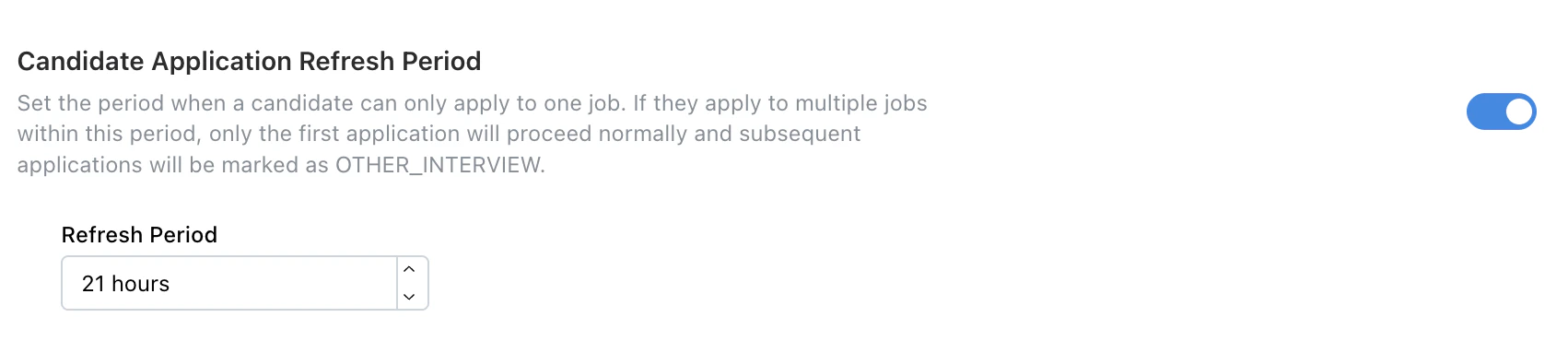
Candidate Application Refresh Period
Phone Line Type Filtering
- Tenzo automatically checks whether a candidate’s phone number is a mobile, landline, or VoIP number before sending SMS.
- Landline and fixed VoIP numbers are excluded from SMS outreach. These numbers cannot receive texts, so Tenzo skips SMS for those candidates. Non-fixed VoIP numbers (such as Google Voice) can receive texts and are included in SMS outreach.
- No configuration is required. This check runs automatically as part of outreach.
- Phone line type also feeds into Fraud risk evaluation (see Video Interview Settings). VoIP numbers raise the candidate’s risk level.
Video Interview Outreach Settings
Interview Link Expiration
- Controls whether and when the interview link expires.
- Default: No Expiration (unless configured otherwise).

Video Interview Link Expiration
Reminder Emails
- Configures how often and how many reminder emails are sent to candidates who have not completed their interview.

Video Interview Reminder Emails
Also send interview link via SMS
- When enabled, candidates with a phone number on file receive an SMS containing their video interview link in addition to email (if your org sends the link by email).
- Useful when candidates are more responsive to text or when email deliverability is uncertain.
{{candidate_name}} and {{interview_link}} in the copy. You can add multiple messages in sequence (for example, a short intro text followed by a second message with the link).
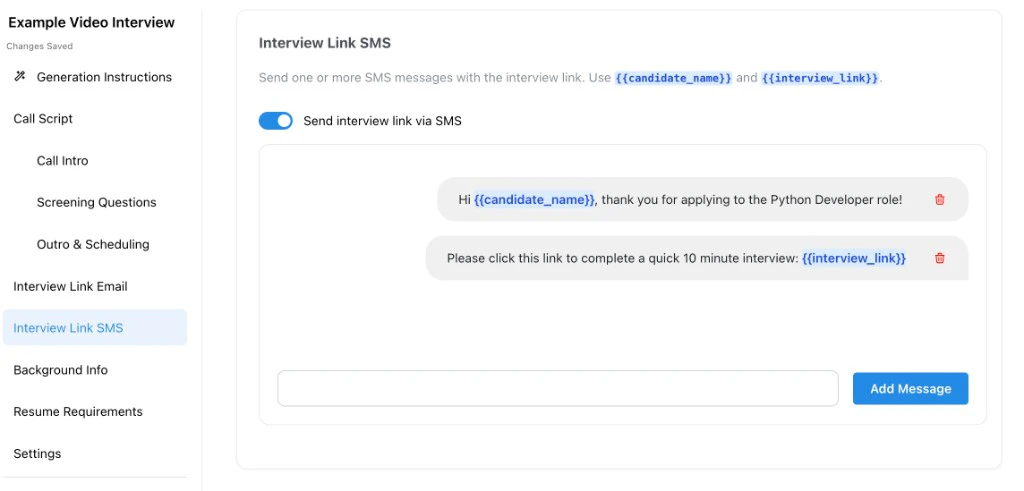
Interview Link SMS — message sequence and variables
Candidates Schedule Video Interview
- If enabled, candidates will be sent a link to schedule their video interview at a specific day/time.
- If disabled, candidates may conduct the video interview at any time directly from their interview link.
- Optional behavior: require candidates to provide a reschedule reason.
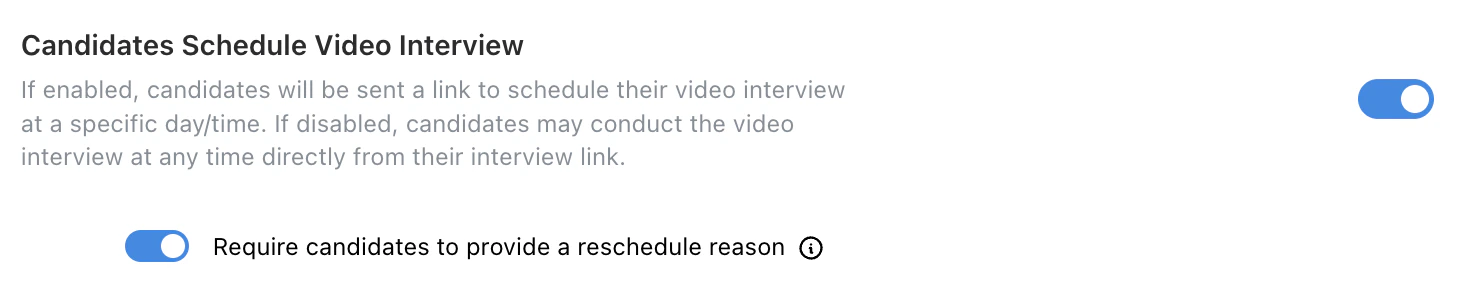
Candidates Schedule Video Interview
Outreach Emails
Enable emails from AI recruiters.
Outreach Emails
Schedule Follow-Up
Enable automatic scheduling of follow-up calls for candidates who score above the passing threshold. Use Calendar scheduling look-ahead buffer to control how soon Tenzo may offer next-round interview slots after the candidate completes the AI interview. For example, a 4-hour buffer means a candidate who finishes at 2:00 PM will only see follow-up interview slots at 6:00 PM or later. Set this to 0 hours if candidates may schedule immediately. Meeting Location sets how the follow-up is held. Organizations using individual calendars see a Video option: Tenzo creates a Teams or Google Meet link from the selected follow-up user’s connected calendar, and falls back to a phone interview if that user cannot create a video meeting. Domain-wide calendar orgs still choose Teams, Google Meet, or Zoom explicitly.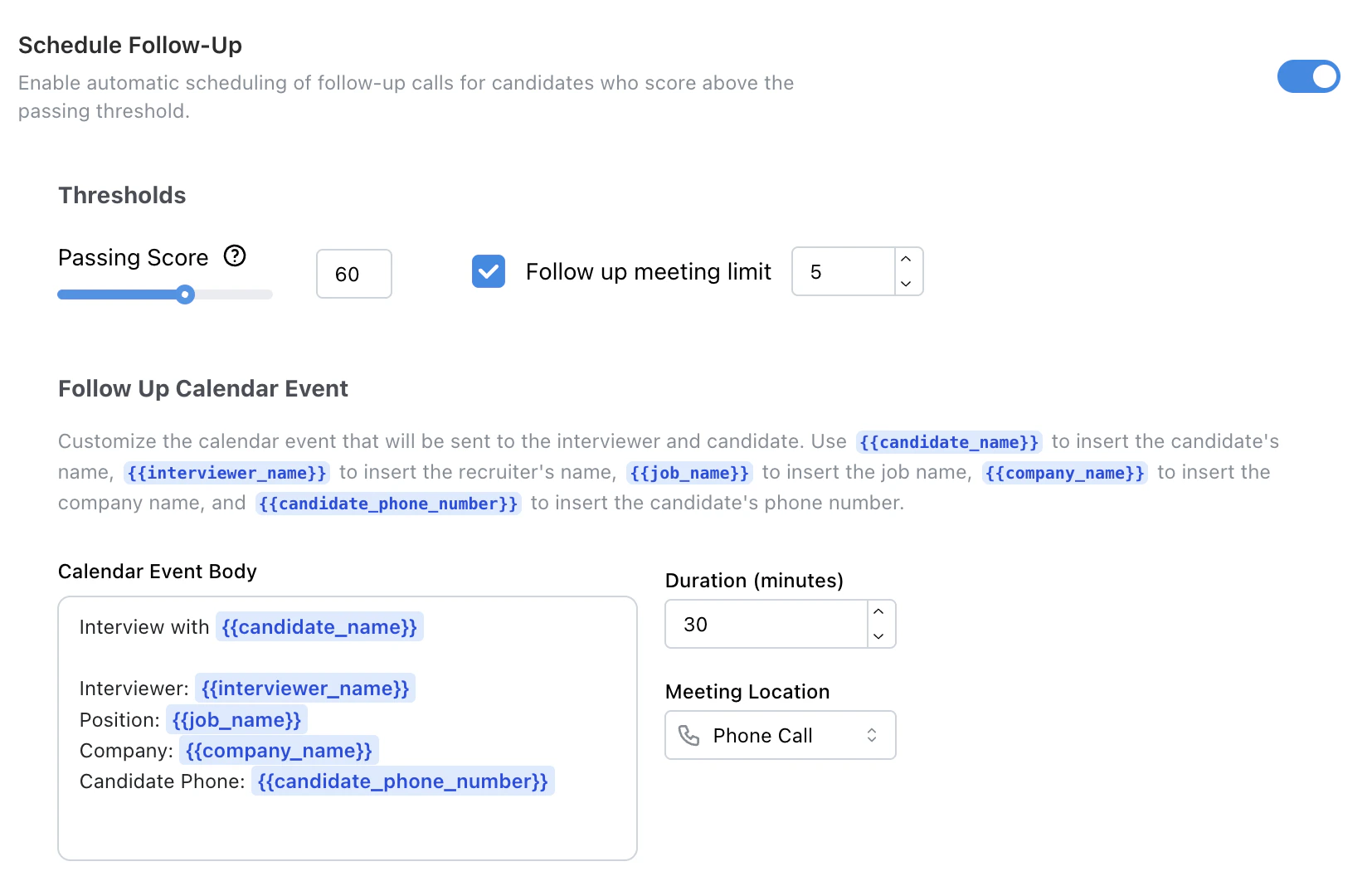
Schedule Follow-Up
Branding Settings
External Job Name
- Sets the job title that is shown externally to candidates.
- Options:
- Use same internal job title for external job name
- Provide a custom external title

External Job Name
Keep job name in sync with ATS
- Shown only on jobs linked to an ATS. Hidden for jobs created entirely in Tenzo.
- When on, Tenzo keeps the internal job name (the sidebar title) matched to the current ATS title, including the requisition-id suffix used at create (
Job title - 229098). The sidebar title is read-only and explains that the ATS owns it — not a parent template. - When off, ATS sync leaves the internal name alone. Anyone who can edit the job can rename it in the sidebar, including jobs created from a hybrid or script template.
- Turn on and save to pull the current ATS title immediately. Turning the setting off keeps the name as-is and unlocks the field.
- Existing ATS jobs stay off until someone opts in, so shipping this setting does not rename jobs already in Tenzo. New ATS jobs start on, so a stub title at create is replaced when the ATS sends the real title on the next sync.
Brand
- Selects which brand profile is applied to this job. Candidates see this brand’s name and logo — in interviews, emails, SMS, calendar invites, and the video interview pages — instead of the internal organization name.
- Create brands and set a default under Admin → Organization & Users. See Organization Branding.

Brand
Job Board Integration
Call New Applicants From Job Board Postings
- Toggles whether Tenzo automatically calls new applicants from connected job boards (for example, Indeed or ZipRecruiter).
- Usage: Configure which postings to monitor for automatic outreach.
- Enabling & Implementation: The Tenzo support team must first enable this feature for your organization. Contact support or your representative to have this feature enabled.
Results Settings
Emails for Interview Results
- Determines which email addresses receive interview result summaries for this job.
- Emails are kept in sync automatically with the recruiters on the job (from an ATS integration) and any emails set on the job’s template, including removing an email once it’s no longer supplied by either source. Once you manually edit this field, it stops syncing automatically until you edit it again.
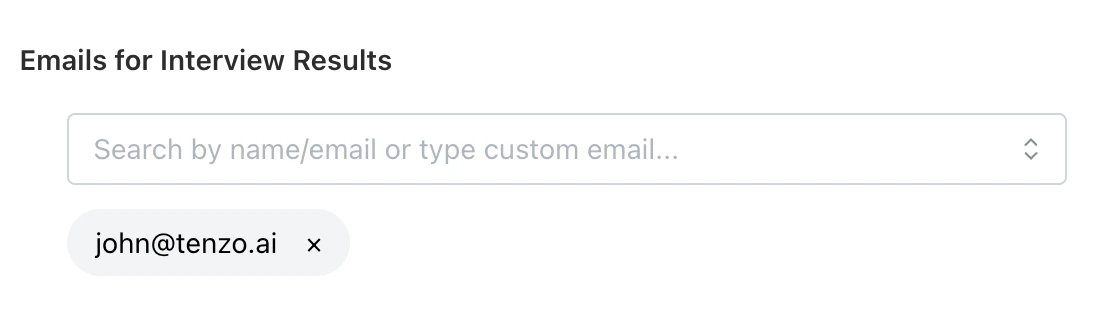
Emails for Interview Results
Email Notifications
- Controls whether email notifications are sent for key candidate events on this job such as call completion.

Email Notifications for Recruiters
Make All Shared Transcript Links Public
- When enabled, every shared transcript link for the organization behaves as publicly accessible (anyone with the URL can open it), subject to your normal link-sharing flows.
- Use this only when your policy allows broader access to transcript links by default.

Make All Shared Transcript Links Public
Sharing a transcript link
Recruiters create transcript links from the interview view. Open a completed interview, then choose Share in the toolbar (tooltip: Share transcript link with others).
Share transcript link from the interview toolbar
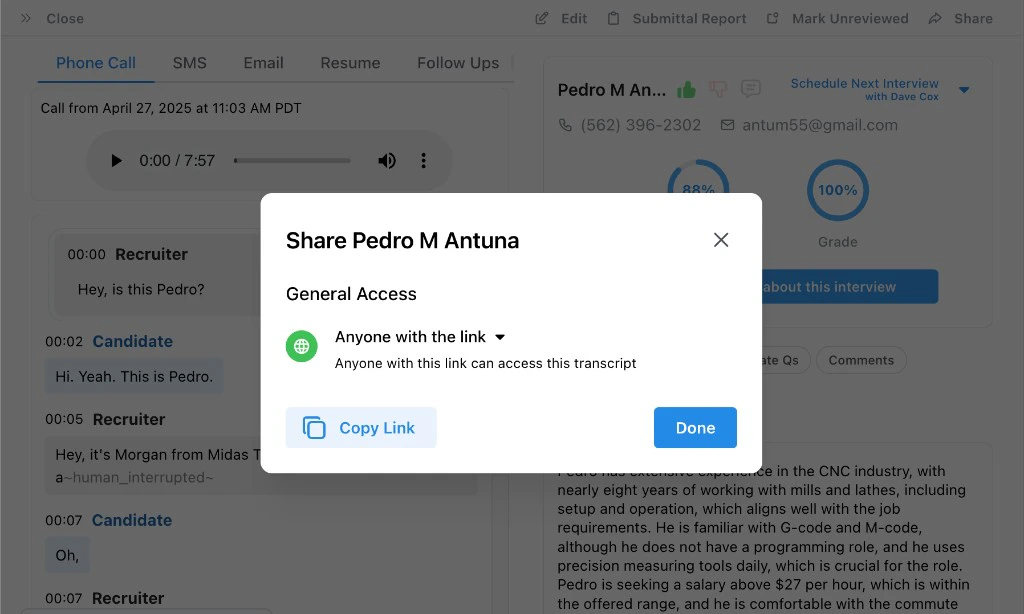
Share dialog — access and copy link
Auto-match sourcing
- When a job becomes active, Tenzo can automatically source, score, and add candidates through the standard sourcing pipeline up to a configured cap.
- Typical controls include a maximum number of candidates to add, a minimum star rating, and whether candidates must meet all minimum requirements before they are auto-added.
- Admins can set the behavior as optional (each job may override) or required (same configuration for every job).
- This reduces manual sourcing work for high-volume roles while keeping volume predictable.
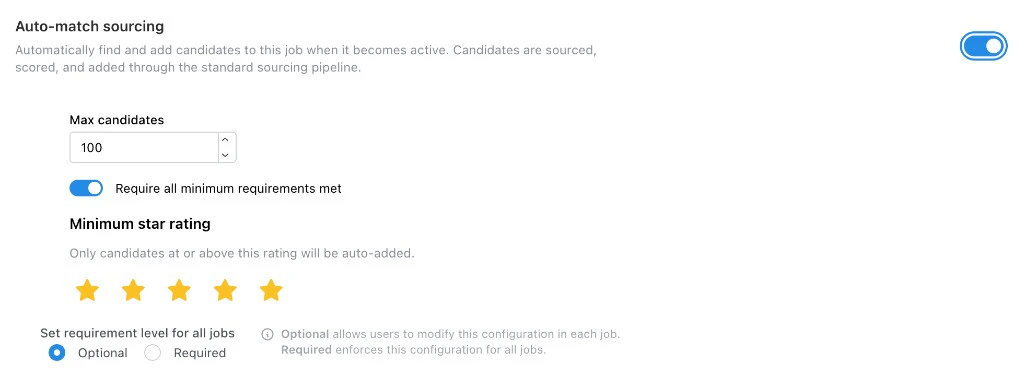
Auto-match sourcing
Eligible for Tearsheet Sync
- Controls whether this specific job can receive candidates from Bullhorn tearsheets or JobDiva hotlists during ATS sync.
- Default is enabled, so linked jobs continue syncing as they do today unless you disable this setting.
- Disable it on jobs you want excluded while leaving tearsheet sync enabled for other jobs in the same organization.
- This setting appears only for organizations with Bullhorn or JobDiva integrations.
Skip Questions from Recent Interviews
- See Skip Questions from Recent Interviews for full behavior (lookback window, beta notes, and how skipped items appear in grades).
- In short: for candidates who recently completed another interview in your org, overlapping logistics / compliance-style questions may be skipped to avoid repetition.
Offer Alternative Jobs on Knockout Failure (Beta)
- During a live phone interview, if a candidate fails a knockout screening question, Tenzo can offer up to 3 alternative open jobs from the same organization instead of ending the conversation with no path forward.
- The system uses AI to rank and match alternative roles based on the candidate’s profile, not a random list of jobs.
- If a suitable match exists, the interviewer pivots mid-call to present the option. The candidate can accept and continue into that job’s interview flow immediately, or decline.
- Intended for talent communities or high-volume recruiting where a candidate may be a strong fit for a different role even when they do not meet the knockout criteria for the primary job.
- Applies to live phone interviews only. This setting does not affect video interviews.
General Application (Beta)
- When enabled, the job acts as a general application intake: at the end of the interview, candidates are matched to open roles instead of receiving a traditional pass/fail grade for a single job.
- If matching roles exist, the candidate can choose one and start that job’s interview flow immediately.
- If no matching roles are available, the interviewer explains that there is no current opening, thanks the candidate, and ends with a normal goodbye. The call does not hang up immediately.
- Shown in the product only when your organization has the General Application feature enabled.
- As with similar controls, you can set whether this behavior is optional per job or required for all jobs at the organization level.

General Application (Beta)
AI Interview Behavior
AI Resume Review Only
- Controls whether this job should run resume review without candidate-facing AI interviews or AI interview outreach.
- When enabled, the job can still run resume review, but Tenzo blocks AI interview entry points such as pending call creation, phone and video outreach, interview links, reissues, scheduling, and redirects into the job.
- When disabled, candidates can receive AI phone or video interviews according to the job’s outreach configuration.
- Candidates who would have moved into Outreach for AI interview outreach are instead parked in Not eligible for outreach (
SKIP_OUTREACH). Turning AI Resume Review Only off allows candidates to re-engage with AI outreach again.
Resume Screening
- Enables automatic filtering of candidates based on resume requirements. The specific resume requirements may be configured in the Resume Requirements tab in the job configuration sidebar.
- Sourced candidates are automatically excluded from resume screening — they skip resume review entirely and go straight to outreach.
- Candidates who fail resume review can be manually moved to the interview stage by recruiters.
- In your ATS configuration settings, you may optionally set a stage candidates who pass or fail the resume review will be moved to.
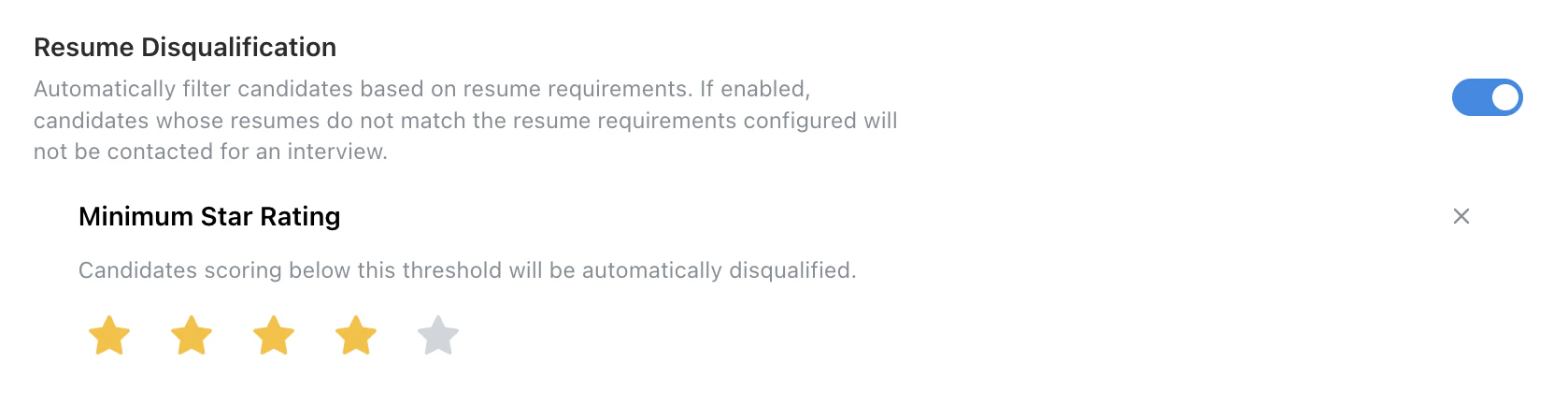
Resume Screening
Include Resume in AI Caller Context
- When enabled and a resume is available, the candidate’s resume is included in the AI caller’s context during the conversation so the interviewer can reference their background when answering questions.
Rejection Emails
- Controls whether rejection emails are sent when a recruiter thumbs down a candidate or the candidate is dispositioned in the ATS.
- A thumbs-down only schedules a rejection email when Tenzo also rejects the candidate in the ATS.
- See Rejection Emails for full behavior and toggle-by-toggle details.
- Additional options:
- Include recommended alternative roles (shows candidates other open positions they may be a good fit for)
- Rejection email delay — how long to wait before sending the rejection email (default 48 hours, range 0–336 hours). The send time is snapped to the job’s outreach hours, and the email is skipped if the candidate is no longer in a failing state at send time. Also used for resume-feedback emails.
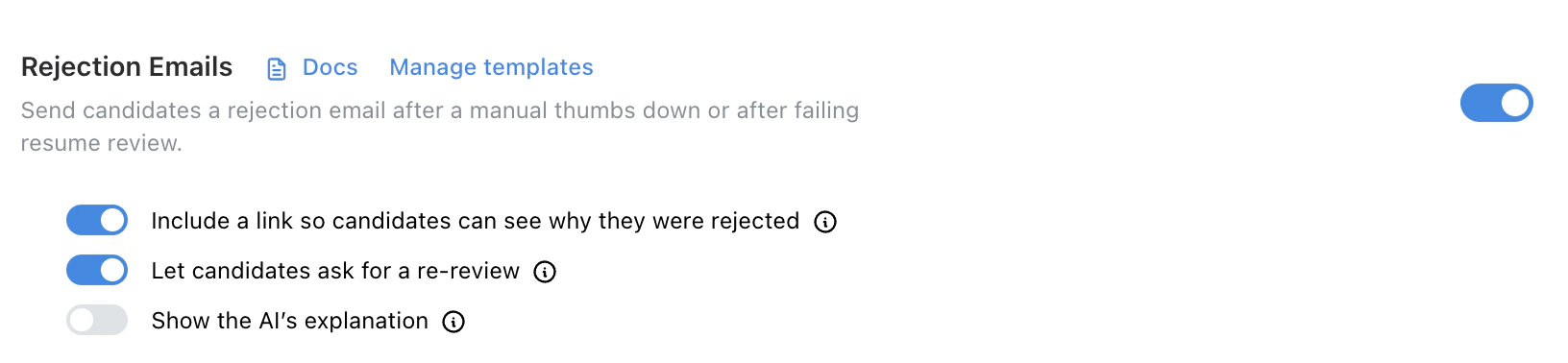
Rejection Emails
Rejection Email Template
- Select which email template is used for rejection messages. This allows you to customize the messages sent to candidates if they receive a rejection.
- See Rejection Email Templates for variables and template behavior.

Rejection Email Template
Resume Feedback Emails
- Controls whether resume feedback emails are sent when a candidate doesn’t pass resume screening.
- Resume feedback emails give candidates transparency into what didn’t match and the opportunity to provide additional context.
- See Resume Feedback Emails for full behavior and toggle-by-toggle details.
- Additional options:
- Include recommended alternative roles (shows candidates other open positions they may be a good fit for)
- Candidate re-review requests (always enabled — candidates can submit additional context for reconsideration)
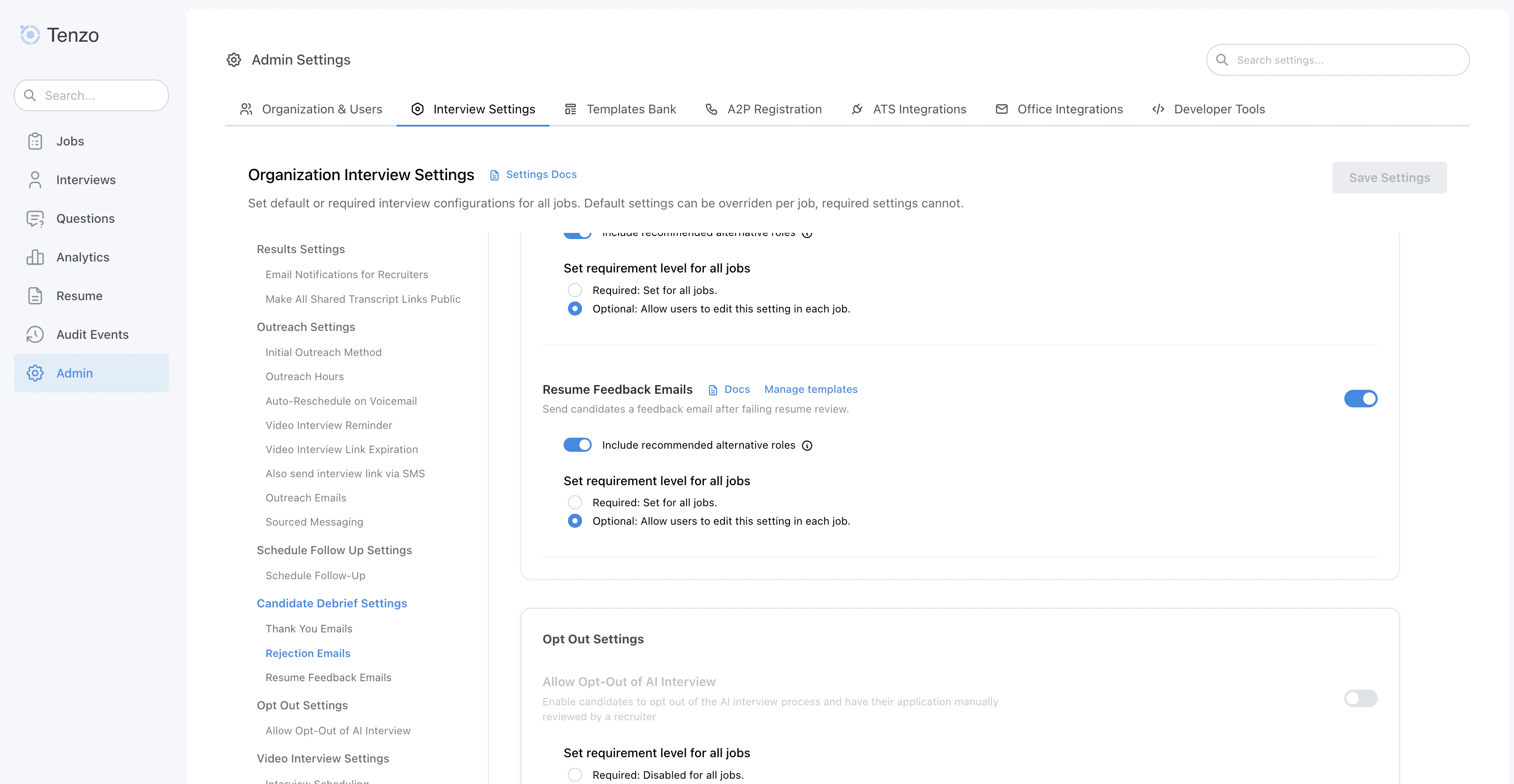
Resume Feedback Emails
Resume Feedback Email Template
- Select which email template is used for resume feedback messages. This allows you to customize the messages sent to candidates when they don’t pass resume screening.
- See Resume Feedback Email Templates for variables and template behavior.
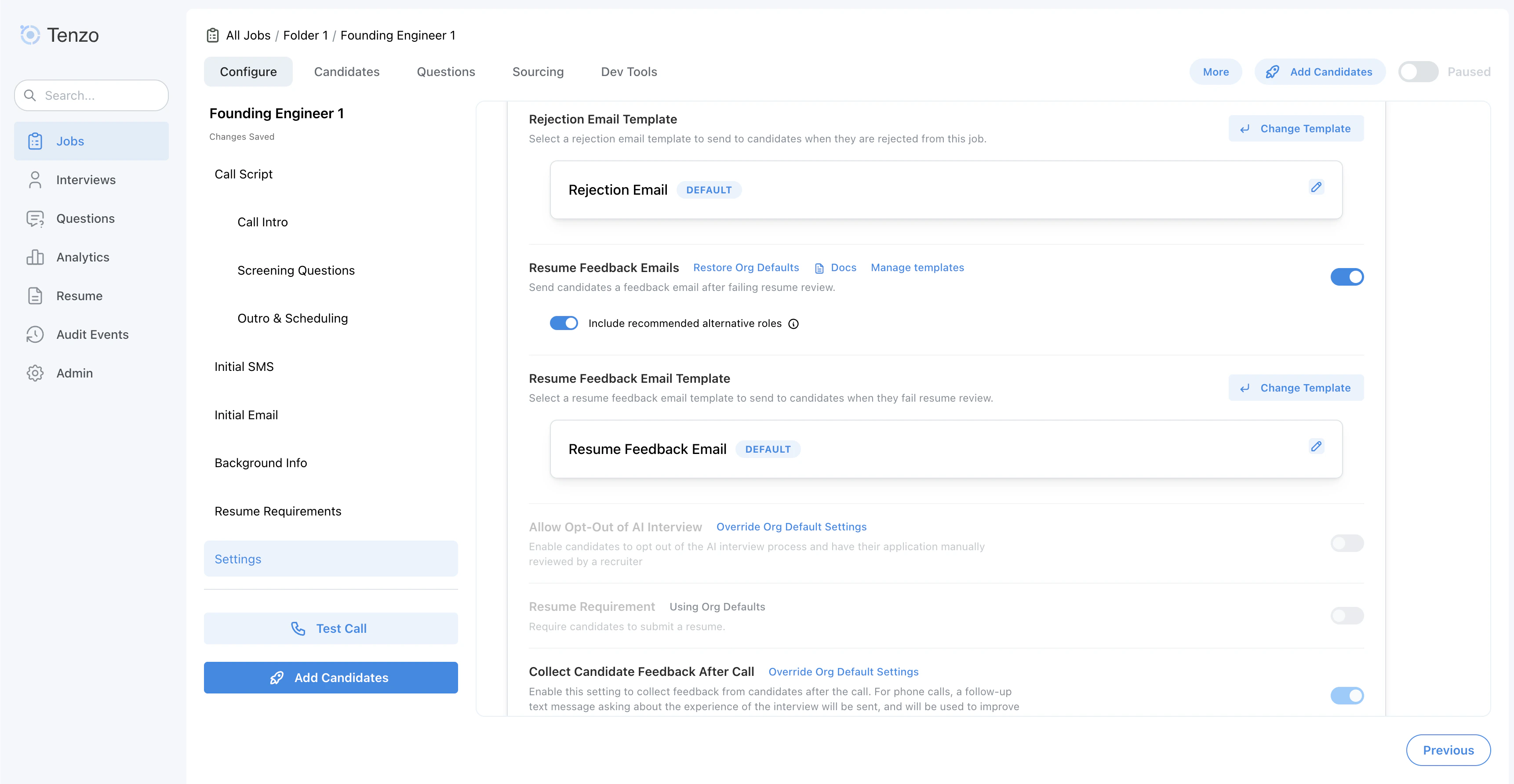
Resume Feedback Email Template
Interview Rejoin Intro
- Controls the greeting spoken when a candidate rejoins an interview they didn’t finish. By default, the AI improvises a short “welcome back” line. When this setting is on, the AI instead speaks a fixed, org-defined (or per-job) message every time — useful for orgs that want to guarantee specific wording, such as re-stating recording consent, is delivered exactly the same way on every rejoin.
- Template: the message spoken on rejoin, in place of the improvised greeting. Supports
{{candidate_name}},{{ai_name}}, and{{job_name}}variables. - Jobs can supply their own template from the script editor’s intro section unless this setting is marked Required — see Required vs Default Settings.
- Require this message to be delivered without interruption: when on, the candidate cannot talk over this greeting — it always finishes playing before the AI listens for a response.
- Intended for rejoin greetings that carry consent or compliance language that must be spoken in full.
- Video interviews: fully enforced.
- Phone calls: best-effort only. The rejoin greeting already plays at the lowest available interruption sensitivity, but our phone platform has no way to fully block a candidate from talking over it, the way video interviews can.
- If a candidate interrupts anyway, the interruption isn’t queued or replayed afterward — the greeting simply continues to completion.
- Jobs can override this independently of the template above (unless the org marks it Required) — a job can require uninterrupted delivery even while using the org’s own template text, or opt out even while using its own.
Allow Opt-Out of AI Interview
- Allows or disallows candidates to opt out of the AI interview process.
- This setting governs only the human-review opt-out flow (“I’d rather talk to a person”). It does not affect how the AI handles a candidate who asks not to be contacted (always ends the call and lands in Consent Revoked) or who simply declines the job (always a brief polite close, landing in Not Interested) — those behaviors are always on.
- When disabled, the AI never offers an opt-out — on phone calls, SMS/WhatsApp, and email alike. If a candidate asks for a human or to skip the AI, the AI reassures them that a recruiter reviews every application and encourages them to complete the short pre-screen so the recruiter has their answers. Candidates are not moved to Opted Out and no opt-out notification is sent.
- Where the candidate lands depends on how they opt out:
- Web/video interview opt-outs — the opt-out form, an individual opt-out link, or asking to opt out during the interview itself — mark the candidate Opted Out. A recruiter is emailed and the ATS AI Opt Out Stage is used when mapped. Consent is not changed on any channel: opting out is a request for a human on that job, not a consent revocation.
- Phone/SMS opt-outs and pre-apply opt-outs also mark the candidate Opted Out.
- Whichever way the opt-out arrived, a candidate who later submits the web interview form without the AI opt-out box is opted back in and returns to outreach, unless their texting is still suppressed by an SMS opt-out.
- To share an org-level opt-out page before a candidate applies, copy your Pre-apply opt-out link from Admin Settings → Organization & Users → Pre-apply opt-out link.
- Candidates can submit their email/phone to opt out of all AI interviews for your organization.
- If a candidate opts out, they will not be screened for any interviews and will be marked as Opted Out across all jobs in your organization.

Allow Opt-Out of AI Interview
Resume Requirement
- Specifies whether a resume is required for candidates to proceed. This setting only applies to video interviews, where a resume upload field is provided as either optional or required.
- Details: Returning candidates who already have a resume on file see a “Resume on file” indicator on the interview form and are not required to upload a new one, even when this setting is set to required.

Resume Requirement
Collect Candidate Feedback After Call
- Enables the in-app feedback form after web/video interviews when turned on.
- Phone interviews: Tenzo sends a follow-up SMS asking for a 1–5 rating when the candidate finished a trusted screen, including graded Failed Knockout outcomes (even first-question knockouts). Interviews where the candidate dropped out early do not receive the SMS. On jobs with scheduled follow-up enabled, a candidate who passes screening is asked to book first, so their feedback SMS is deferred until they book (and is not sent if they never book) — failed-knockout and other non-scheduling candidates are unaffected. See Post-Interview Feedback for the full send conditions, message content, and consent requirements.

Collect Candidate Feedback After Call
Enable Transcript Redaction
- Toggles redaction of personal information such as sensitive family or personal information details from interview transcripts, according to your organization’s redaction template.
- Scope: this setting applies to phone and web interviews only. It does not apply to Meeting Copilot meeting transcripts — those are governed by the constraints configured on the meeting’s note template.
- When enabled, Tenzo redacts the saved transcript before running post-interview processing. Grading, summaries, ATS notes, result PDFs, and other outputs generated from the transcript use the redacted version — not the original spoken record.
- Expected behavior: If information was removed or replaced in the transcript, it will also be absent (or shown with a redaction marker) in downstream results such as question grades, the interview summary, and ATS-facing notes. Customers should expect post-interview artifacts to match what appears in the redacted transcript.
- Exception — Work Accommodation Review: When the Work Accommodation Review setting is enabled, that check runs on the unredacted transcript (before redaction) so the reviewer can see the underlying statement. The verbatim quote it captures appears in the Work Accommodation Review section of the results email, ATS note, and PDF — so that one section can contain text that is otherwise redacted elsewhere.
- Admins can always view the full unredacted transcript if required.

Enable Transcript Redaction
Thank You Emails
- Controls whether thank you emails are sent after candidates complete their interview.

Thank You Emails
Thank-You Email Template
- Chooses which template is used for post-interview thank-you emails. A default thank you email will be used if a custom template is not selected.

Thank-You Email Template
Summary
- Selects which summary template the AI uses to generate a post-interview summary for this job to standardize specific summary information to extract. This summary can be viewed in the Tenzo app interview results, as well as the pdf and note posted to the ATS and the result email sent to the recruiter.

Summary Template
Suggested Follow-Up Templates
- Manages templates that guide human recruiters on follow-up questions when reviewing transcripts. Custom suggested follow-up templates allow the grading agent to follow standardized instructions when generating potential follow-up questions.
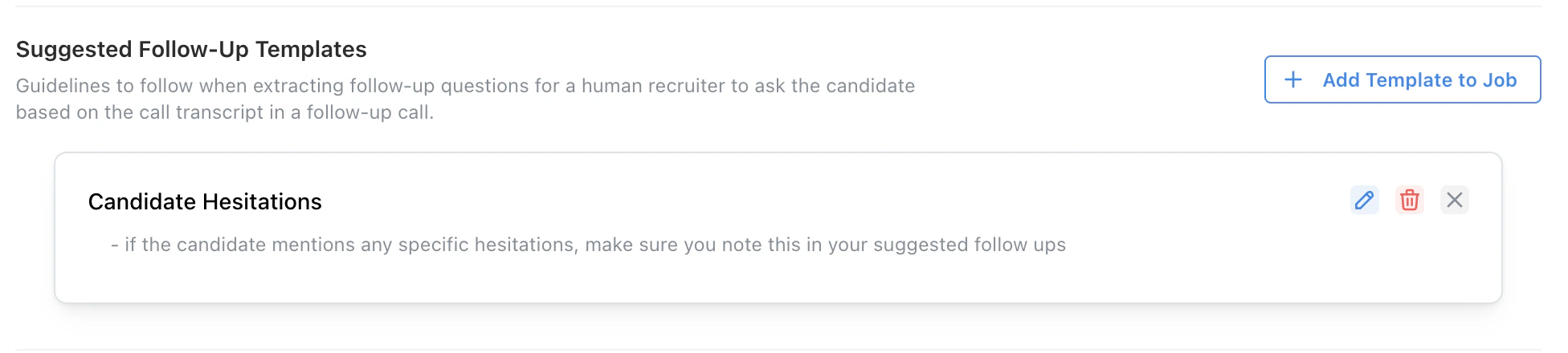
Suggested Follow-Up Templates
Job pause and capacity
Auto-pause job when enough candidates pass
- Automatically sets the job to paused once N candidates have a completed interview at or above a score threshold.
- By default the threshold follows your organization’s AI Interview above threshold score; you can turn off Use AI Interview above threshold score and set a custom minimum score instead.
- Admins can make this configuration optional per job or required for all jobs.
- Helps cap pipeline volume when you only need a fixed number of qualified completes before pausing outreach.
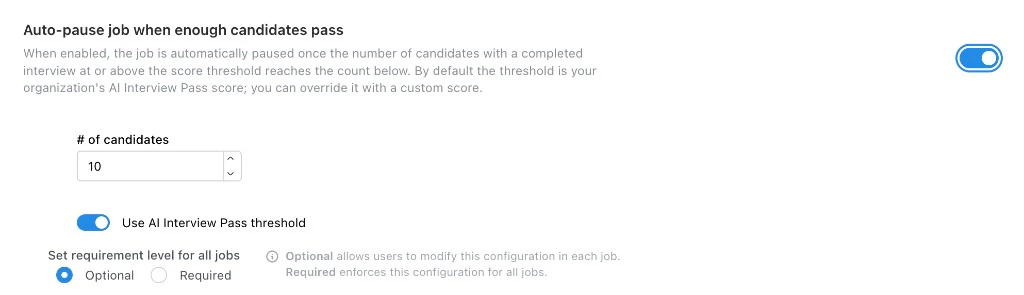
Auto-pause job when enough candidates pass
Paused job behavior
- Controls candidate-visible behavior while a job is paused:
- Send job paused emails — notify candidates that the job is paused.
- Allow interviews — allow candidates who already have a non-expired interview link to finish the video interview while the job is paused. If this setting is not enabled, candidates will see a message that the job is not currently accepting interviews if they access the video interview link while the job is paused.
- Pausing does not cancel a phone screen the candidate already scheduled. Tenzo still calls at that time. Booked video interviews still depend on Allow interviews above. See Pausing a Job.

Paused job behavior
Hybrid templates (organization / job defaults)
Hybrid Templates
- Org or job setting that allows template-based jobs to use per-section AI generation (see Hybrid Job Templates).
- When on, template authors can mark whole script sections as Use exactly vs AI generated and add AI Blocks in screening questions; when off, those hybrid controls are not available for that scope.
Video Interview Settings
Space Bar to End Response
- This option is no longer available. Video interviews no longer let candidates press the space bar to end a response; turn-taking is automatic. An admin-only leftover of this setting may still appear in product; it has no effect.
Restrict Video Interviews to Desktop Only
- Restricts video interviews to desktop devices only so mobile users see a message requiring desktop access. When candidates conduct interviews on desktop, they are more likely to have stable internet access and limited background noise and distraction during the video interview.

Restrict Video Interviews to Desktop Only
Allowed Interview Locations (IP-based)
- Restricts where candidates can take a video interview based on their IP geolocation.
- If a candidate’s detected country is outside the allowed list, Tenzo adds a flagged event “Location outside allowed countries” and shows a red warning icon next to the location above the transcript (hover to see the detected country + allowed countries).
- Note: This is best-effort based on IP; VPNs/proxies can change the detected country and may also show “Likely VPN or Proxy”.
Require Screen Share
- Requires candidates to share their entire screen during the video interview.

Require Screen Share
Additional Policies
- Require candidates to accept extra employer-defined policies before starting the interview (each appears as its own checkbox below the standard Terms & Conditions).
- For each policy, set a policy name, then use Add link to define one or more links with a display name, a variable name (used in the template), and the URL. In the Acknowledgement statement, write the checkbox label and reference variables as
{{variable_name}}so they render as clickable links in context (use Preview to check). Use Add policy to add another policy block.
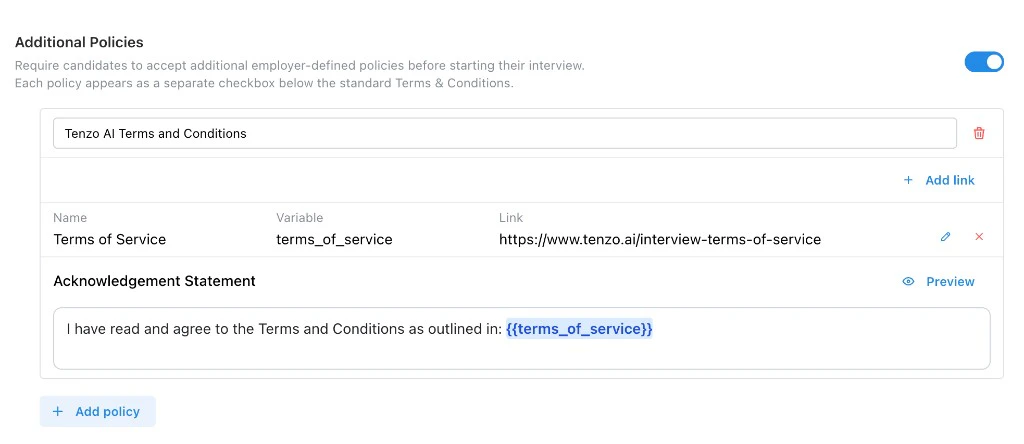
Additional Policies — links and acknowledgement statement
Fraud risk evaluation
Evaluates multiple signals when a candidate is added to a job and combines them into an overall risk level: Low, Medium, High, or Extreme. Evaluation runs on the jobs where it is switched on, and findings appear on a candidate’s interview once the feature is turned on for your organization — covering the applications already evaluated as well as new ones. The level reflects the full set of triggered signals together, so several moderate flags can raise it while a single flag on its own usually lands at a lower tier. Signals that usually describe the same thing count once: a VoIP phone number and a name that doesn’t match that number’s phone records raise the level as one finding, although both appear on the candidate’s interview. The overall level appears in candidate lists and beside the candidate’s name when you open their details. Configuration:- Uses a tiered ladder (Low → Medium → High → Extreme): assign actions such as auto-close (move to a fraud-rejected stage) starting at a chosen tier.
- Coordinate when ID verification applies, either for all candidates or only above a chosen risk tier. The tier option takes effect once fraud risk findings are turned on for your organization; until then a tier-limited setting verifies no one.
Candidate Identity Verification
- Requires candidates to verify their identity with a government-issued ID before starting the video interview.
- Document types eligible for verification can be restricted in-product (government-issued ID types you accept).

Candidate Identity Verification
Avatar Settings
- Upload custom avatars for the caller during video interviews.
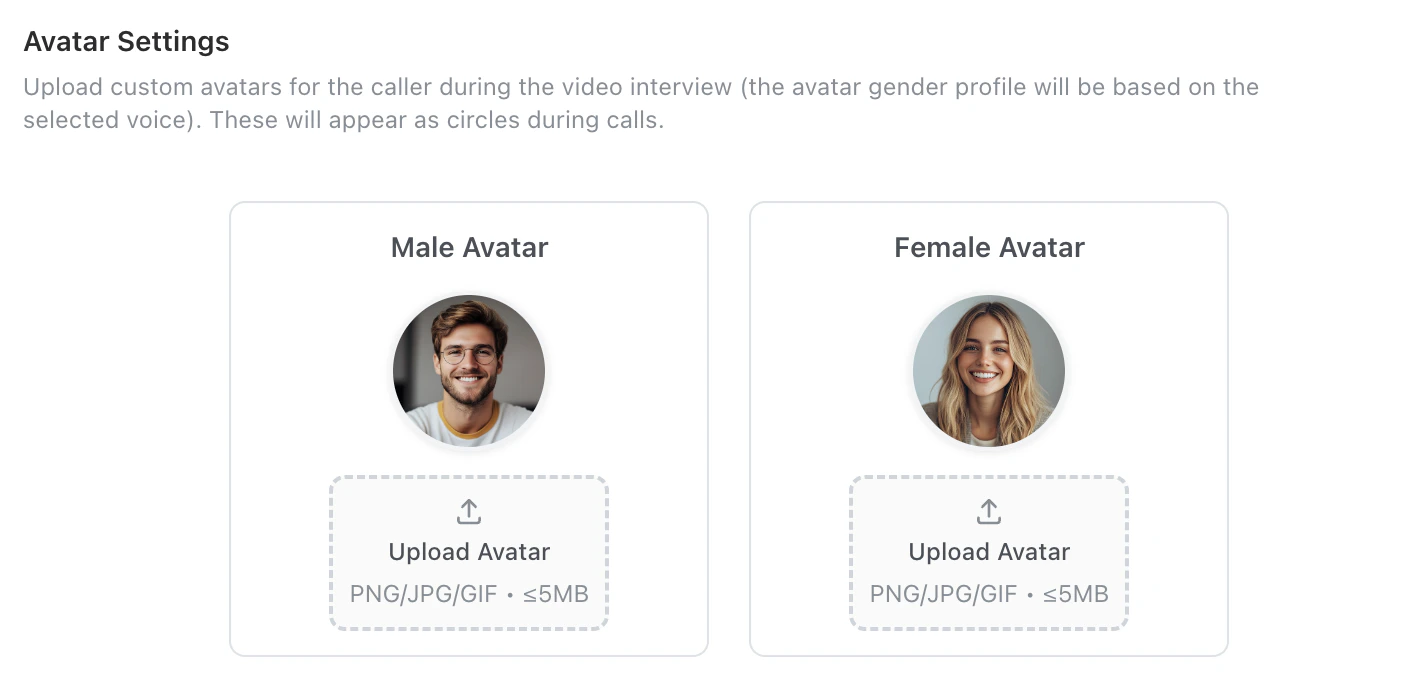
Avatar Settings
Interview Proctoring
During video interviews, Tenzo automatically analyzes webcam and screen share footage to detect potential integrity concerns. This runs automatically for all video interviews. No configuration is required to enable it. Events monitored:- Candidate not in frame - The camera appears unoccupied or obstructed.
- Multiple people detected - Additional people are visible in the background.
- Candidate looking away - The candidate is consistently looking off-screen, possibly toward notes or another device.
- Face partially out of frame - The candidate appears to be avoiding the camera.
- Tab switch - If the candidate switches tabs or applications while screen sharing is enabled, the screen content is captured and analyzed for cheating tools (AI assistants, search engines, notes, etc.).
Support-only advanced settings
Caller LLM options
- Visible for full-access / support users: configure which LLM platform and model pairs participate in the racing system used for AI phone calls.
- Not required for normal recruiting operations; intended for engineering or support tuning.