> ## Documentation Index
> Fetch the complete documentation index at: https://f4c7a9e2d8b1-docs.tenzo.ai/llms.txt
> Use this file to discover all available pages before exploring further.
# Rejection Email Templates
> Customize the email candidates receive after a manual thumbs-down
## Overview
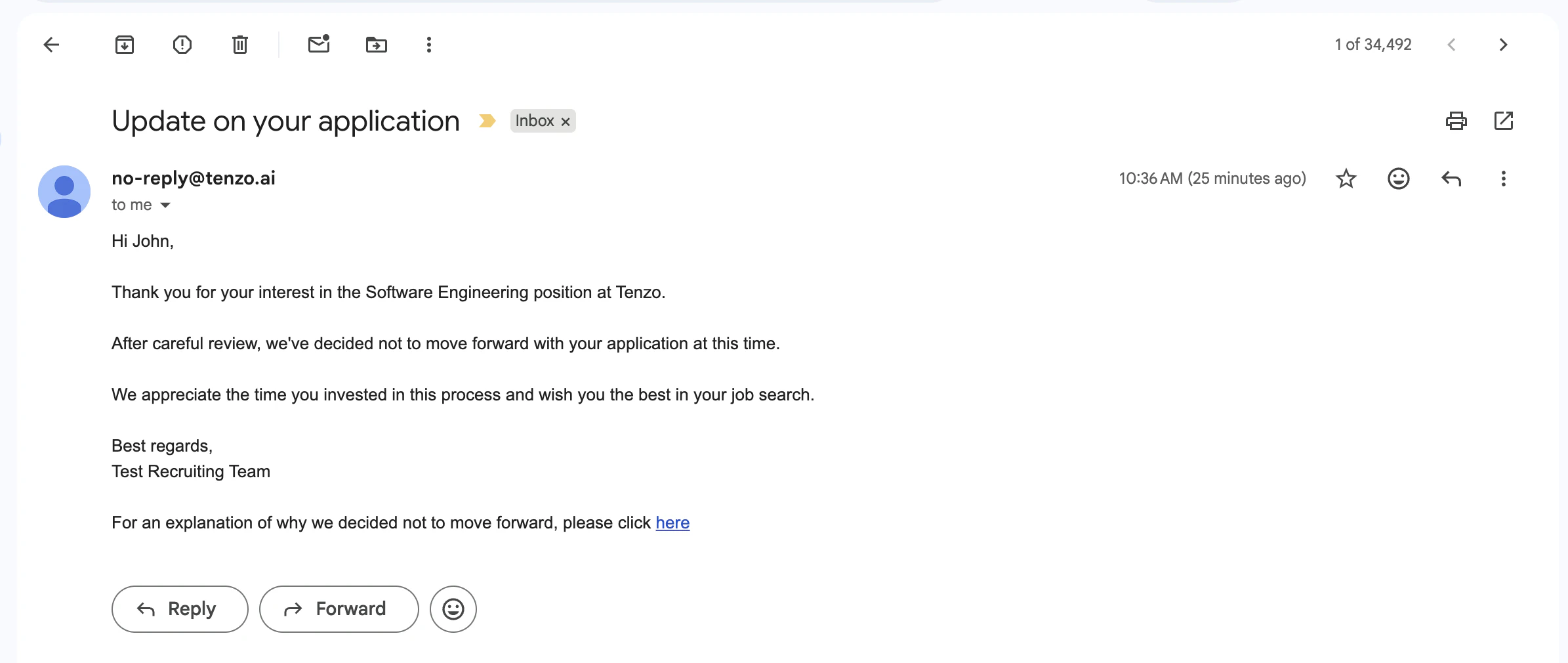
Rejection Email Templates define the **subject** and **body** sent to candidates when a recruiter manually rejects or thumbs down a candidate and **Rejection Emails** are enabled.
These templates are managed from **Admin > Templates Bank > Rejection Email Templates**.
For the settings that control *when* emails are sent, see **[Rejection Emails (Settings)](/settings/rejection-emails)**.
These templates are for rejection emails sent after a manual thumbs-down. For templates used when a candidate doesn't pass resume screening, see **[Resume Feedback Email Templates](/templates/resume-feedback-email-templates)**.
***
## How template selection works
Tenzo selects a template in this order:
1. **Job-specific template** (if configured on the job)
2. **Org default template** (your default in the templates manager)
If no template is available, Tenzo cannot send a rejection email.
***
## Supported variables
When a rejection email is sent, Tenzo replaces `{{variable}}` placeholders in the **subject** and **body** with values from the candidate record, job configuration, and linked ATS job—the same substitution logic used for other candidate-facing templates.
**Candidate**
* `{{candidate_name}}` — the candidate's name
* `{{candidate_phone_number}}` — the candidate's phone number, when available
**Job and recruiter**
* `{{job_name}}` — the candidate-facing job title
* `{{company_name}}` — your organization's name for the job
* `{{ai_name}}` — the AI caller name configured on the job
* `{{recruiter_phone_number}}` — the outbound call number configured on the job
**Interview scheduling (when configured on the job)**
* `{{estimated_duration_minutes}}` — expected interview length based on screening questions
* `{{expiration_days}}` — how long web interview links stay valid
**ATS job attributes**
Any field from the linked ATS job is available using dot notation (for example, `{{location.city}}` or `{{custom_field_values.customText1}}`). The exact keys depend on your ATS integration and the job's cached attributes.
If a placeholder has no matching value at send time, it is left unchanged in the email.
For more examples of how variables are used across interviews and outreach, see **[Variables](/getting-started/advanced-create-interview#variables)**.
***
## How settings affect the final email
Your chosen template is the base email content. The **Rejection Emails** settings can modify what is appended:
* **Include recommended alternative roles**:
* When enabled, Tenzo appends a section showing other open positions the candidate may be qualified for, with links to view details and express interest.
See **[Rejection Emails (Settings)](/settings/rejection-emails)** for the full setting explanations.
***
## Managing templates
In the templates manager you can:
* Create additional templates
* Edit template subject and body
* Set a template as the **default** for new jobs
* Delete templates you no longer need